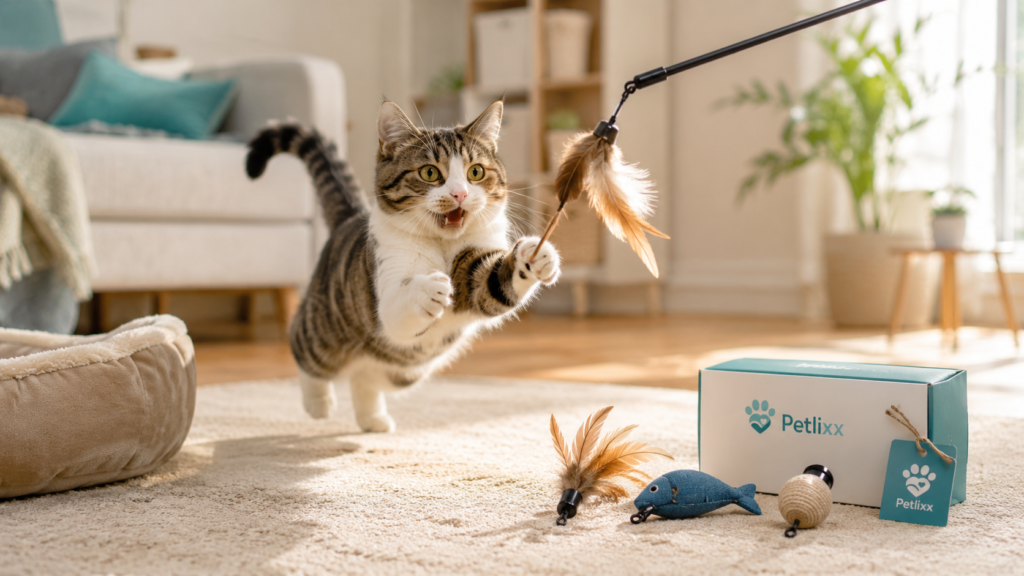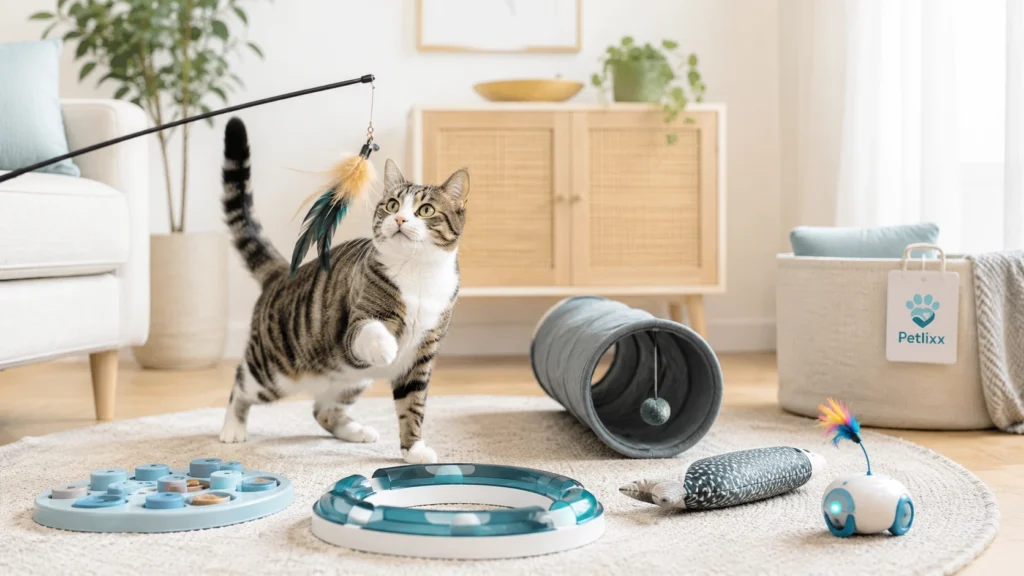
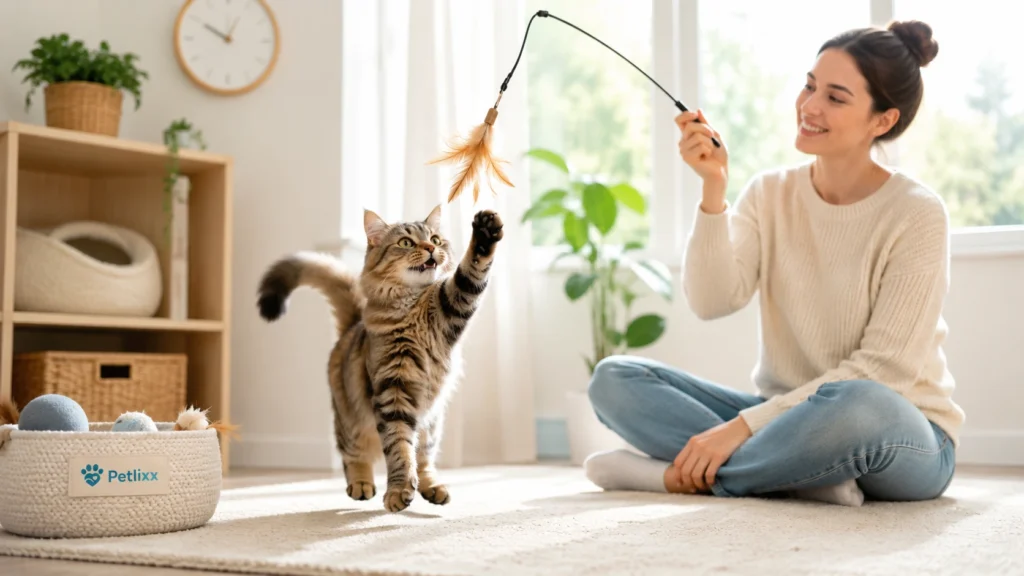
How long should I play with my cat? A practical starting point is several short play sessions spread across the day, with the duration adjusted to your cat’s age, health, mobility, energy, and interest. Many cats respond better to repeatable sessions than to one long workout that becomes tiring or frustrating.
Daily play is only one part of a balanced indoor routine. For a broader comparison of wand toys, puzzles, track balls, tunnels, and other activities, see our best interactive cat toys for indoor cats guide.
This article focuses specifically on time: how long each session should last, how often to play, how routines change by life stage, which toys fit different cats, and when to stop. The goal is not to impose one rigid number. It is to build a safe routine that your cat wants to repeat.
Quick Answer
Most cats benefit from short, regular play sessions rather than one long session. A useful starting point is two or three sessions of about 5-10 minutes, then adjust according to interest, age, mobility, and recovery. Stop earlier when your cat disengages, becomes overstimulated, or shows discomfort.
Key Takeaways
- There is no single perfect daily play duration for every cat.
- Several short sessions are often easier to repeat than one long session.
- Kittens may prefer more frequent play, while senior cats may need slower, lower-impact movement.
- Interest, body language, breathing, and recovery are more useful than forcing a timer.
- Wand toys, balls, puzzle feeders, kicker toys, and tunnels support different play styles.
- String, wire, ribbon, and feather toys should be supervised and stored after use.
- A sudden decline in activity, pain, limping, or unusual breathing should be discussed with a veterinarian.
Table of Contents
How This Guide Was Prepared
This guide combines current veterinary and feline-environment guidance with practical decision criteria: life stage, mobility, confidence, preferred play behavior, session engagement, recovery, supervision needs, and household routine. The recommendations are flexible because cats differ widely in motivation and stamina.
Petlixx has not clinically tested every play duration or every toy category discussed here. Product recommendations are included only when the product’s verified design fits the use case. The daily schedule and comparison tables are editorial tools designed to help owners observe and adjust, not replace individual veterinary advice.
Why Daily Play Matters for Indoor Cats
Direct answer: Daily play gives indoor cats a repeatable outlet for stalking, chasing, pouncing, batting, searching, and catching. It also adds movement and novelty to an environment that can otherwise become predictable. The activity should match the individual cat instead of forcing high-intensity exercise on every age or personality.
The FelineVMA environmental needs guide recommends giving cats opportunities for play and predatory behavior, including interactive toys that imitate prey. It also notes that cats should be able to capture the “prey” intermittently to reduce frustration.
That does not mean every session must involve jumping or running. A shy cat may prefer a cloth toy moving slowly behind a box. A food-motivated cat may engage more with a puzzle feeder. A senior cat may enjoy gentle floor-level batting. The purpose is meaningful engagement, not maximum intensity.
How Long Should I Play With My Cat Each Day?
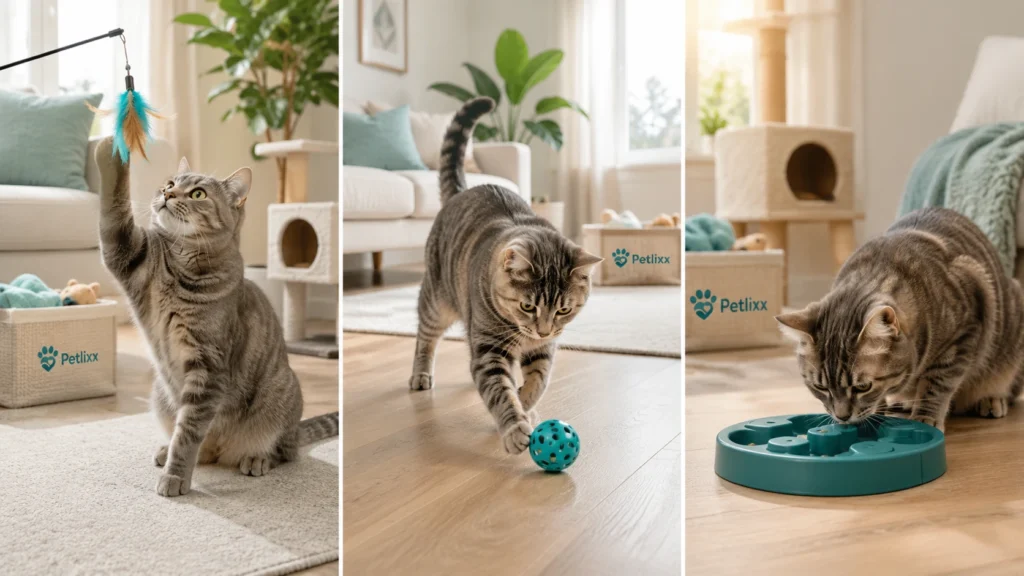
Direct answer: If you are wondering how long should I play with my cat each day, start with two or three short sessions totaling roughly 15–30 minutes, then adjust. Some cats will want more, while others prefer a few focused minutes. The best duration is the amount your cat can enjoy consistently without fear, frustration, exhaustion, pain, or loss of interest.
The VCA Animal Hospitals guide to cat play and toys gives a practical reference of several 10-minute sessions per day and recommends adjusting session length to the cat’s interest. Treat that as a flexible starting point, not a rule every cat must meet.
When deciding how long should I play with my cat, remember that total daily time matters less than consistency and response. Many owners ask, “How long should I play with my cat a day?” Ten minutes of focused stalking and chasing may be more useful than thirty minutes of waving a toy that the cat ignores. Watch the full pattern: approach, chase, catch, rest, and willingness to return later.
Why Short Sessions Often Work Better
Short sessions fit the stop-and-start pattern of feline play. They also make it easier to change the toy, room, movement style, or time of day before the activity becomes repetitive. A cat that loses interest after four minutes has still completed a useful session; extending it to ten minutes may only teach the cat to ignore the toy.
Why Every Cat Needs a Different Routine
When you ask, “How long should I play with my cat?”, consider age, confidence, body condition, joint comfort, previous play experience, and household stress. These factors can all change how long a cat wants to play. Use the same starting routine for several days, record what happens, and adjust one variable at a time. This makes the schedule easier to evaluate than changing the duration, toy, room, and movement all at once.
How Often Should I Play With My Cat?
Direct answer: If you are wondering, “How long should I play with my cat?”, remember that most indoor cats benefit from play every day, ideally divided into more than one short session. Morning and evening often work well because many cats are naturally active around those periods, but the best schedule is the one that matches when your cat is alert, interested, and ready to play.
If you are wondering how often should I play with my cat, start with two short daily sessions. Add a third session only if your cat still shows interest and recovers comfortably afterward. Cats with a high play drive may enjoy more frequent sessions, while calm or older cats may prefer one active session combined with one gentle food-search or batting activity.
Daily Play for Indoor Cats: Build a Repeatable Routine
- Choose two regular windows when your cat is usually awake.
- Start with a familiar toy and a short session.
- Allow pauses, hiding, stalking, and successful catches.
- Finish while the cat is still engaged rather than waiting for complete boredom.
- Store supervised toys and offer a calm transition such as rest or part of a meal.
Why Splitting Cat Play Across the Day Works Better
When deciding how long should I play with my cat, dividing activity across the day can reduce the pressure on one session to provide all the exercise and enrichment. A morning wand game can support guided movement, an afternoon puzzle can add food-based problem-solving, and an evening ball or kicker session can offer a different action. This variety matters because cats do not always enjoy the same movement pattern.
How Long Should Each Cat Play Session Last?
Direct answer: If you are asking, “How long should I play with my cat in one session?”, begin with 5–10 minutes, but end the activity according to your cat’s response rather than the clock. Continue while your cat voluntarily stalks, chases, bats, pounces, or returns after brief pauses. Stop when engagement fades or the activity becomes physically or emotionally uncomfortable.
Signs Your Cat Wants to Continue
- Eyes and head continue tracking the toy.
- The cat crouches, stalks, follows, or returns after a short pause.
- The cat remains coordinated and voluntarily re-engages.
- The tail and ears remain compatible with focused play rather than fear or irritation.
- The cat catches the toy and waits for the next movement.
Signs It Is Time to Stop
- The cat walks away repeatedly or begins grooming instead of re-engaging.
- The cat hides, flattens the ears, lashes the tail, growls, or appears frightened.
- Movement becomes uncoordinated, painful, or unusually slow.
- The cat pants, appears breathless, or takes an unusually long time to recover.
- Play turns into repeated attacks on hands, feet, or another pet.
Panting or sudden activity intolerance is not something to train through. End the session, allow recovery, and contact a veterinarian when breathing changes, pain, limping, weakness, or a sudden loss of interest is new or persistent.
How Much Play Do Kittens, Adults, and Senior Cats Need?
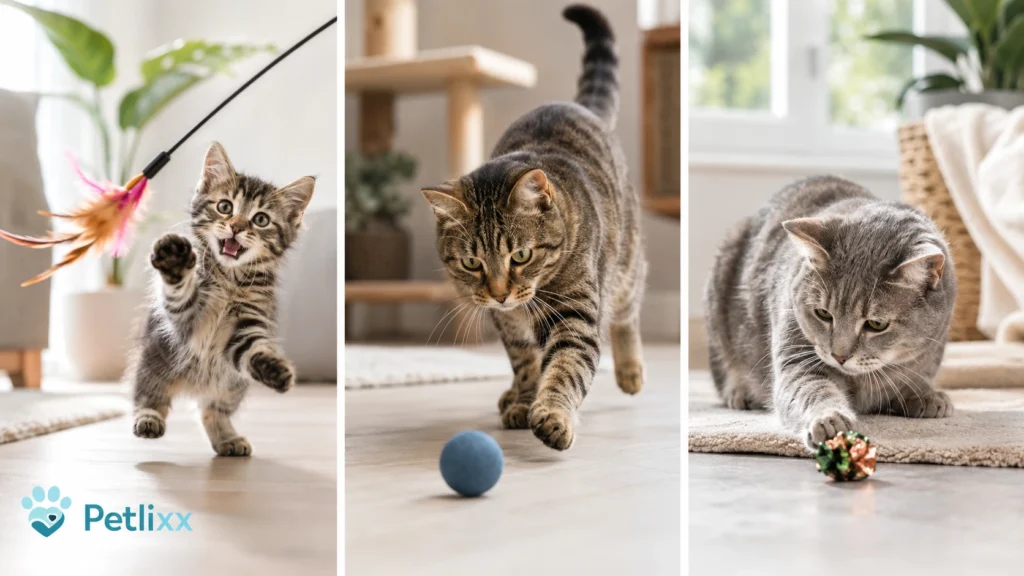
Direct answer: Kittens often prefer frequent short bursts, adults may enjoy a balanced mix of active and food-based play, and senior cats usually benefit from gentler movement with more recovery time. Life stage is a starting point only; health, mobility, confidence, and individual play drive should determine the final routine.
| Life Stage | Practical Starting Routine | Best Movement Style | Main Adjustment |
|---|---|---|---|
| Kitten | 3-5 short sessions when awake and interested | Fast changes, short chases, safe climbing | Avoid hands and feet as toys; supervise small parts |
| Active adult | 2-3 sessions of about 5-10 minutes | Wand chase, balls, tunnels, kicker play | Rotate activities and include successful catches |
| Calm adult | 1-2 active sessions plus food-based enrichment | Slow stalking, puzzle feeder, floor play | Use motivation and novelty rather than forcing speed |
| Senior cat | 1-3 gentle sessions depending on comfort | Floor-level wand, soft ball, easy puzzle | Reduce jumping, distance, speed, and session length |
Kittens
Kittens may play intensely for a few minutes, stop abruptly, then become active again later. Several brief opportunities usually fit this pattern better than one long session. Use toys that keep teeth and claws away from hands, inspect small attachments, and avoid leaving strings or ribbons accessible after play.
Adult Indoor Cats
Adult cats often respond well to a mixed routine: one owner-led chase, one independent toy, and one food-based challenge. An adult that appears “lazy” may simply dislike the movement style. Try prey that crawls, flutters, hides, pauses, rolls, or dispenses food before concluding that the cat does not enjoy play.
Senior Cats
Senior cats can still benefit from play, but the activity should respect mobility and medical conditions. Keep toys close to the floor, use shorter distances, provide non-slip surfaces, and allow longer pauses. A sudden reduction in willingness to jump, chase, or climb may indicate discomfort and deserves veterinary attention.
What Is the Best Time to Play With a Cat?
Direct answer: The best time is when your cat is naturally awake and interested. Many cats respond well in the morning or evening, before a meal, or after a period of rest. Avoid waking a sleeping cat for a rigid schedule. Observe the times your cat already seeks attention, watches movement, or begins exploring.
A pre-meal session can create a simple sequence of stalk, chase, catch, and eat. An evening session may help redirect attention into a planned activity before the household becomes quiet. However, the schedule should remain flexible. A cat that is hiding, resting deeply, or avoiding interaction is not ready just because the clock says it is playtime.
Which Toys Are Best for Daily Cat Play?
Direct answer: The best routine combines different functions rather than several toys that all move the same way. Use an owner-led wand for stalking and chasing, a ball or track for batting, a puzzle feeder for food-based problem-solving, and a kicker or tunnel for grabbing, hiding, or ambushing.
Wand Toys for Guided Play
Wand toys let you control speed, direction, height, distance, and pauses. Our best cat wand toys for indoor cats guide compares feather, cloth fish, ball, ribbon, and other styles so you can match the attachment to the cat’s preferred movement.
For a simple supervised option, the Petlixx Cat Teaser Wand Toy is available with cloth fish, feather, and small ball variants. These options support different movement patterns, but the toy should still be inspected and stored after each session.
Puzzle Feeders for Food-Motivated Cats
Puzzle feeders can turn part of a meal into searching, reaching, sliding, or rolling. Begin with visible food and an easy action. Count the food as part of the normal daily allowance, clean food-contact surfaces, and reduce difficulty if the cat walks away without understanding how to access the reward.
Balls, Tracks, Kickers, and Tunnels
Balls and tracks support batting and short chases. Kicker toys suit cats that grab and bunny-kick. Tunnels add hiding, ambushing, and running paths. These toys can be combined with a wand, but inspect seams, frames, bells, feathers, and small decorations before use.
Sample Daily Cat Play Schedule
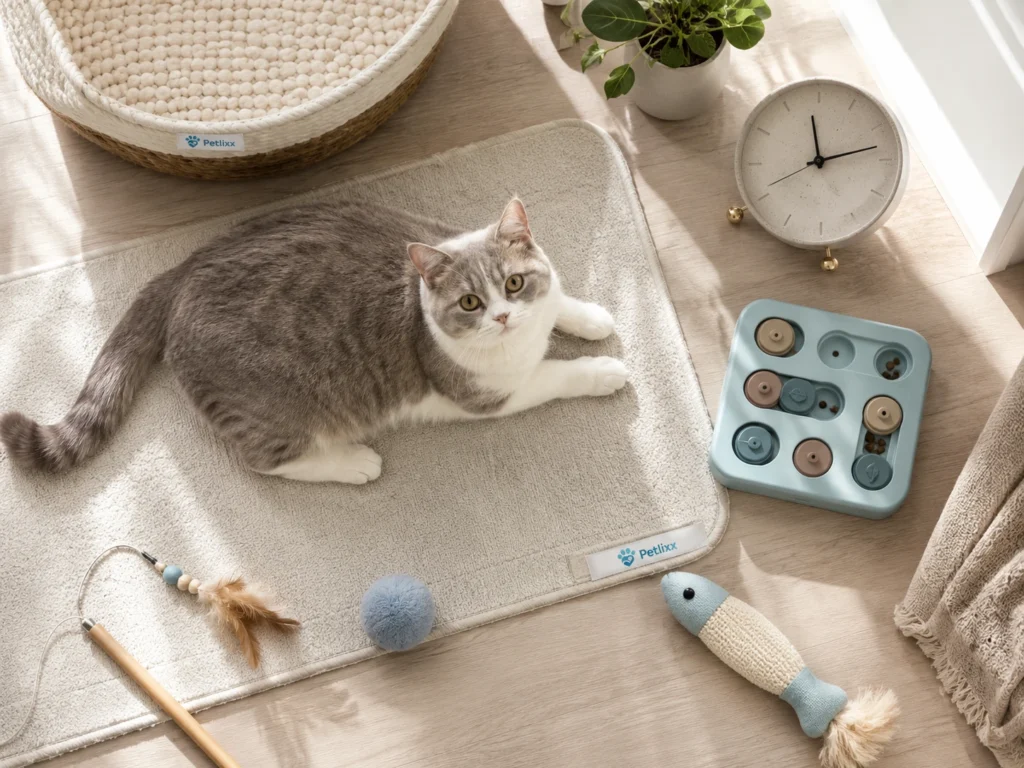
Direct answer: A useful schedule alternates active, independent, and food-based play instead of repeating one toy. Start with two or three short windows, keep the routine for several days, and adjust according to engagement. The examples below are starting points, not fixed prescriptions or medical exercise plans.
| Cat Profile | Morning | Afternoon | Evening |
|---|---|---|---|
| Kitten | 5-minute wand chase | Ball or tunnel exploration | 5-minute wand or kicker session |
| Active adult | 8-10 minute guided play | Independent track or prey toy | 5-10 minute chase before a meal |
| Food-motivated adult | Short ball or wand game | Part of meal in easy puzzle | Short stalking and catch session |
| Shy cat | Slow cloth toy near cover | Treat search in familiar room | Gentle floor-level wand play |
| Senior cat | 3-5 minute gentle movement | Easy puzzle or soft ball | Short low-impact session with pauses |
Keep a simple note for one week: toy used, approximate duration, level of interest, signs of fatigue, and recovery. This small record is more useful than guessing because it shows which combinations the cat actually chooses and whether the routine remains sustainable.
How to Use a Cat Wand Safely During Daily Play
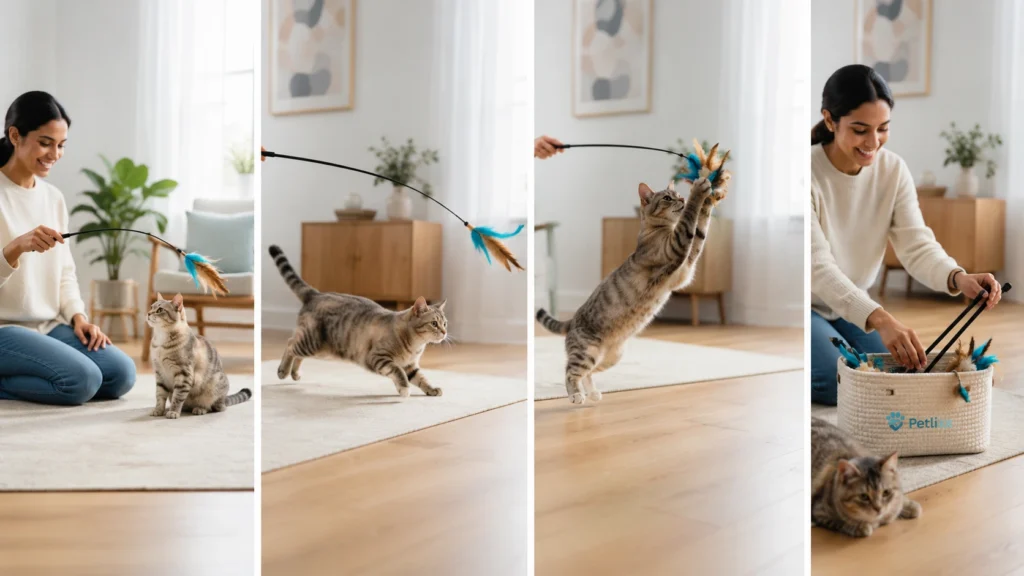
Direct answer: Move the attachment away from the cat like prey, add pauses and hiding, allow regular catches, and keep hands away from the target. Supervise the entire session, inspect the connection points, and store the wand afterward. Strings, wires, ribbons, feathers, and small attachments should not remain accessible without supervision.
- Begin with slow movement so the cat can locate and stalk the target.
- Move the toy away from the cat rather than repeatedly pushing it toward the face.
- Use furniture edges, boxes, or tunnels to create short disappear-and-return sequences.
- Let the cat catch the attachment regularly so the game has a successful outcome.
- Keep the toy away from stairs, fragile objects, open windows, and unsafe jumping routes.
- Stop if the cat becomes frightened, frustrated, painful, breathless, or aggressive.
- Inspect the string, wand, seams, feathers, and attachment point, then store the toy safely.
Benefits and Limits of a Daily Play Routine
Direct answer: A daily routine can add movement, novelty, hunting-style behavior, problem-solving, and shared interaction. Its limit is that play cannot diagnose or treat pain, obesity, anxiety, aggression, or sudden behavior change by itself. The routine should support the cat’s environment, not replace veterinary assessment or broader enrichment.
| Potential Benefit | What the Routine Provides | Important Limit |
|---|---|---|
| Movement | Short opportunities to chase, bat, pounce, or climb | Intensity must match age, health, and mobility |
| Mental engagement | Novel movement, searching, hiding, and problem-solving | A toy that is too difficult or repetitive may be ignored |
| Owner-cat interaction | Predictable shared activity without using hands as prey | Not every cat wants the same amount of social play |
| Routine | Regular opportunities instead of occasional long sessions | A rigid timetable should not override body language |
| Behavioral outlet | Appropriate targets for stalking and chasing | Sudden aggression or withdrawal may require professional help |
Common Cat Play Mistakes
- Forcing a fixed duration after the cat has lost interest.
- Using hands, feet, or clothing as moving prey.
- Keeping the toy permanently out of reach and never allowing a catch.
- Making every session fast, aerial, and high-impact.
- Leaving wand toys, strings, ribbons, wire, or loose feathers unattended.
- Using several toys that all provide the same movement instead of rotating functions.
- Ignoring pain, limping, panting, fear, or a sudden decline in activity.
- Adding food rewards without counting them in the daily food allowance.
- Expecting one toy to solve boredom when the environment lacks hiding, climbing, resting, scratching, or social options.
Frequently Asked Questions
Is 10 minutes of play enough for a cat?
Ten focused minutes can be enough for one session, especially when the cat stalks, chases, catches, and then rests. Daily needs vary, so treat ten minutes as a useful session length rather than a full-day rule. Add another short session when the cat remains interested and recovers comfortably.
How long should I play with my cat before bed?
A short evening session of about 5-10 minutes is a practical starting point. Use a predictable activity, allow a successful catch, and end calmly. Some cats settle well after play followed by a meal, while others become more alert, so adjust the timing to your cat’s response.
Can I play with my cat too much?
Yes, a session can become excessive when the cat is forced to continue after disengaging, becomes frightened or irritated, shows pain, pants, or struggles to recover. Frequent short sessions are usually easier to control than one intense session. Stop early and discuss unusual activity intolerance with a veterinarian.
Should I let my cat catch the toy?
Yes. Allowing regular catches gives the chase a successful outcome and can reduce frustration. Pause briefly after the catch, then restart only if the cat remains interested. Do not pull hard against the mouth or allow the cat to chew and swallow string, wire, feathers, ribbon, or small attachments.
Do indoor cats need play every day?
Most indoor cats benefit from a daily opportunity to play, hunt, search, or solve a simple challenge. The activity can be active or gentle depending on the cat. A senior cat may prefer floor-level batting, while a kitten may choose several short chase sessions across the day.
What should I do if my cat does not want to play?
Change one variable at a time: movement style, toy type, room, distance, speed, or time of day. Try slow ground movement, hiding behind objects, food puzzles, or a quiet ball. A sudden or persistent loss of interest, especially with pain or appetite changes, should be discussed with a veterinarian.
Final Thoughts
How long should I play with my cat? Begin with several short sessions, then let your cat’s engagement, life stage, mobility, and recovery shape the routine. The best schedule is not the longest one. It is the one that remains safe, varied, repeatable, and enjoyable for both the cat and the owner.
Use a small rotation of owner-led, independent, and food-based activities instead of buying many toys that perform the same function. When you are ready to compare current options, browse the verified Cat Essentials collection and choose products that fit your cat’s real play style and supervision needs.
If your cat suddenly stops playing, appears painful, becomes breathless, limps, hides more than usual, or shows a major change in behavior, pause the routine and seek veterinary guidance.