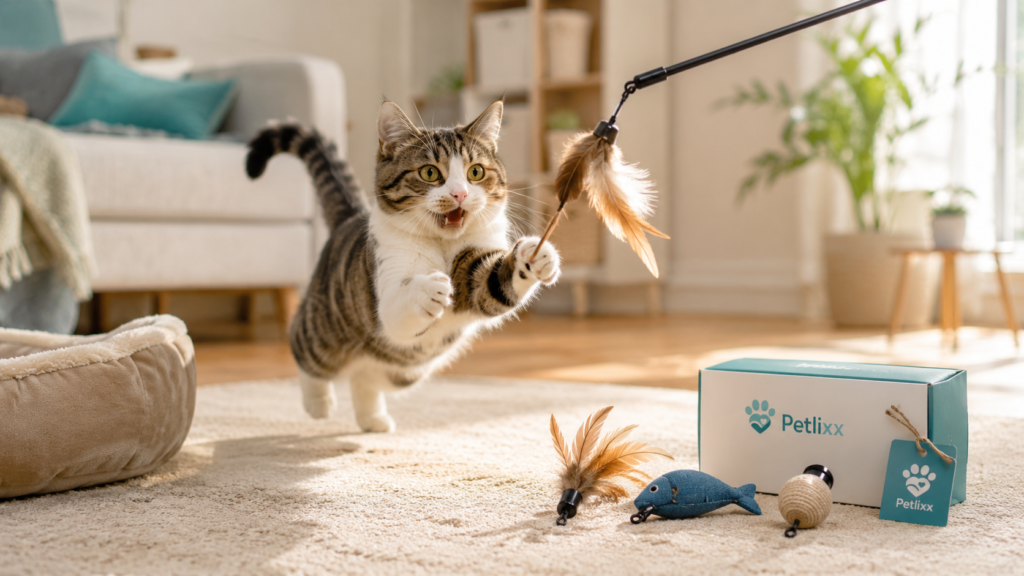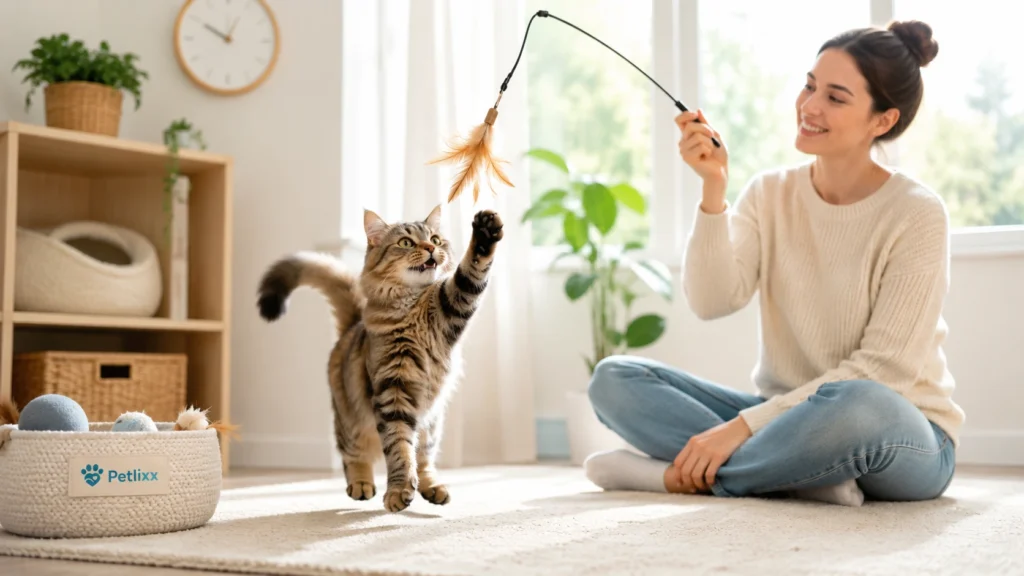
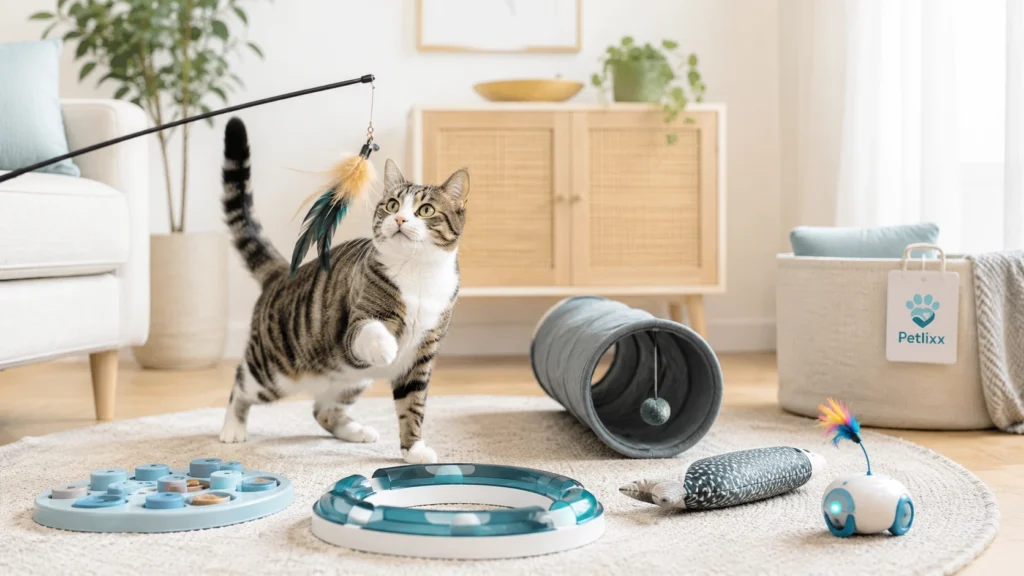
Interactive cat toys can turn an ordinary indoor routine into a more active, varied, and rewarding day. The right toy encourages a cat to stalk, chase, pounce, search, bat, kick, or solve a small food challenge instead of spending every quiet hour sleeping or waiting for attention.
Indoor cats do not all enjoy the same activity. One cat may become excited by a feather wand, while another prefers a rolling track ball, a puzzle feeder, or a toy that moves independently. A useful setup therefore includes different play styles rather than one “perfect” toy that is expected to work for every cat.
This pillar guide compares nine popular toy types, explains which cats they suit, and shows how to build a safe rotation. It also helps you choose among the best interactive cat toys without buying several products that all provide the same kind of stimulation.
Quick answer: a balanced indoor play setup normally combines one owner-led hunting toy, one independent batting or chasing toy, and one food-based enrichment activity. Rotating those options can keep play more interesting while making it easier to match the activity to your cat’s energy level.
Table of Contents
Key Takeaways
- Different toy types support different behaviors, including chasing, pouncing, problem-solving, kicking, and foraging.
- Wand toys are strong choices for guided play and bonding because the owner controls the movement.
- Puzzle feeders and treat toys turn part of a meal into a slower, more focused activity.
- Toy rotation is usually more useful than leaving every toy available all day.
- String, wire, feather, and small detachable toys should be used with supervision and stored safely after play.
What Are Interactive Cat Toys?
Interactive cat toys are toys that invite a cat to respond through movement, hunting behavior, food search, or problem-solving. Some require the owner to move the toy. Others let the cat play independently, and food-based options reward the cat after it completes a small task.
The word “interactive” does not always mean electronic. A simple wand, cardboard box, paper ball, tunnel, or puzzle feeder can be highly engaging when it is used in a way that encourages natural behavior. What matters is the interaction between the cat, the toy, and the activity.
A useful interactive cat toy should be easy to understand, safe for the cat’s size and play style, and interesting enough to create a clear action such as chase, catch, search, bat, or kick. The toy should add variety to daily life rather than replace attention, exercise, or calm social time.
Why Indoor Cats Need Interactive Play
Indoor living protects cats from many outdoor risks, but it can also make the environment predictable. Regular play adds movement, novelty, and a safe outlet for behaviors that resemble hunting. Short sessions can be easier to repeat consistently than one long session that leaves the cat overstimulated or uninterested.
The VCA Animal Hospitals guide to cat play and toys explains that play supports normal predatory behavior and that owners can offer different toy types to encourage activity. The practical lesson is simple: use several forms of play and follow the cat’s response instead of forcing one toy or movement pattern.
Daily play may also help redirect attention away from furniture, hands, ankles, or other unsuitable targets. However, toys should not be treated as a cure for sudden behavior changes. A cat that stops playing, shows pain, or changes activity level unexpectedly may need veterinary attention.
Quick Comparison: 9 Interactive Cat Toy Types
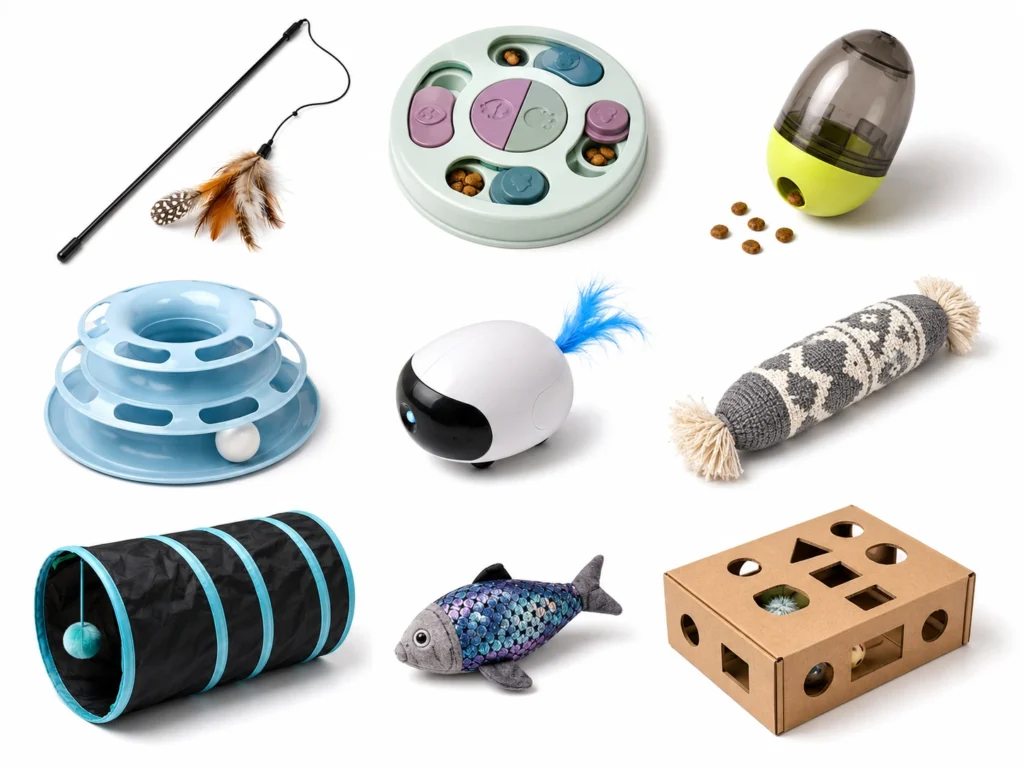
| Toy Type | Best For | Main Activity | Supervision |
| Wand toy | Guided play and bonding | Stalking, chasing, pouncing | Yes |
| Puzzle feeder | Food-motivated cats | Searching and problem-solving | First sessions |
| Treat dispenser | Slow rewards and batting | Pushing, rolling, foraging | Recommended |
| Track ball | Independent indoor play | Batting and chasing | Usually low |
| Automatic moving toy | Cats attracted to motion | Chasing and swatting | Recommended |
| Kicker toy | Cats that grab and wrestle | Holding and bunny kicking | Check condition |
| Tunnel | Hiding and chase games | Running, ambushing, exploring | Usually low |
| Crinkle or prey toy | Solo pouncing | Biting, carrying, batting | Check small parts |
| DIY cardboard toy | Low-cost variety | Searching, batting, exploring | Depends on design |
1. Cat Wand Toys for Guided Hunting Play
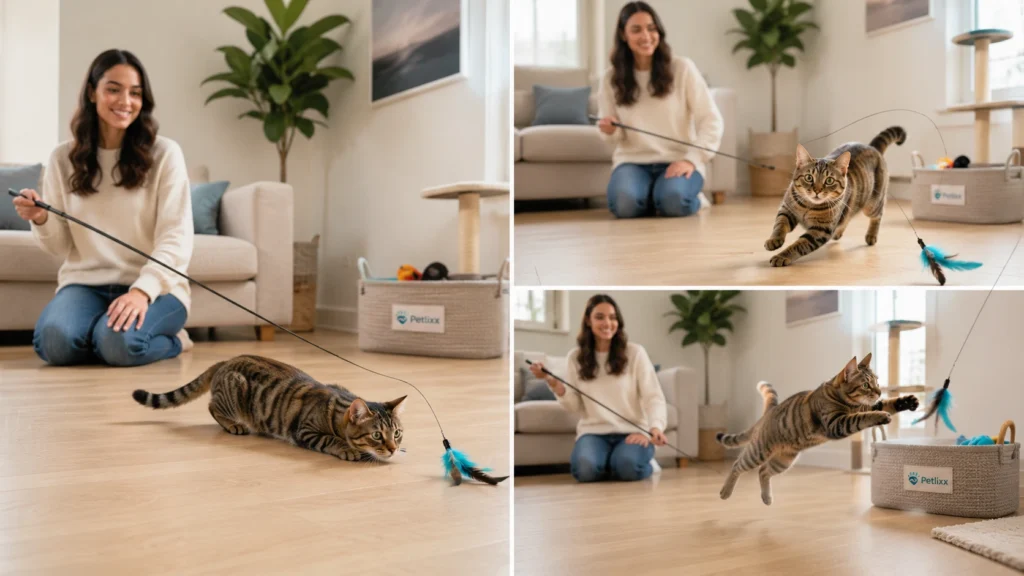
Wand toys are among the most versatile interactive cat toys because the owner controls the speed, distance, direction, and height. That control makes it possible to imitate small prey moving behind furniture, pausing, escaping, and returning.
A good session starts slowly. Let the attachment move away from the cat, disappear briefly, and pause before the next chase. Give the cat regular opportunities to catch the toy instead of keeping it permanently out of reach.
For a detailed comparison of feather, fish, ribbon, wire, and refillable options, read our Best Cat Wand Toys for Indoor Cats guide. It explains how to choose the right length, handle, attachment, and play style.
Petlixx currently offers the Petlixx Cat Teaser Wand Toy with feather, cloth fish, and small ball attachment options. It is designed for supervised indoor play with kittens and adult cats.
2. Puzzle Feeders for Food-Based Enrichment
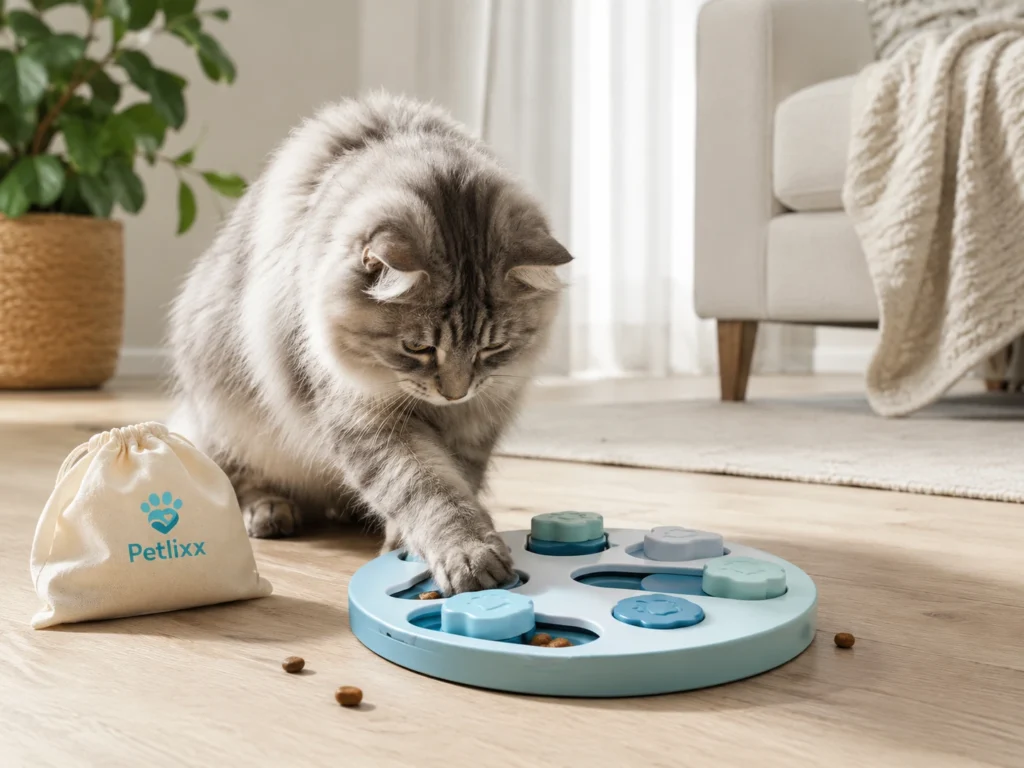
Puzzle feeders ask the cat to move a piece, reach into an opening, slide a cover, or search through compartments before accessing food. They are useful for cats that are strongly motivated by kibble or treats but show little interest in ordinary chase toys.
Start with an easy setup and visible rewards. A puzzle that is too difficult on the first day may cause the cat to walk away. Once the cat understands the action, difficulty can be increased gradually by adding covers, deeper compartments, or smaller food portions spread across several sections.
Food used in puzzle play should be counted as part of the normal daily allowance. The goal is to make a portion of feeding more engaging, not to add unlimited extra calories.
3. Treat-Dispensing Cat Toys
Treat dispensers release small rewards when the cat rolls, pushes, bats, or tips the toy. They combine movement with food motivation and can keep a curious cat occupied during a short independent session.
Choose a dispenser with openings that match the food size. If pieces fall out too easily, the activity ends immediately. If nothing comes out, the cat may lose interest. Adjustable openings are useful when you want to change the difficulty.
These cat enrichment toys work best on a clean, open floor where the cat can move the toy without it becoming trapped under furniture. Wash food-contact surfaces regularly and remove damaged toys.
4. Track Ball Toys for Independent Play
Track ball toys keep one or more balls inside a circular or multi-level track. The cat can bat the ball repeatedly without losing it under a sofa. This makes the design useful for independent play and for homes where loose balls disappear quickly.
Some cats enjoy a basic track, while others respond better when the toy includes a scratch surface, moving feather, or hidden center compartment. Place the track in an area the cat already uses instead of hiding it in a quiet corner.
5. Automatic Moving Toys
Automatic toys use rotating, rolling, vibrating, or pop-up movement to attract attention. They can add variety when the owner is busy, but they should complement owner-led play rather than replace it completely.
Look for a stable design, protected moving parts, an automatic shutoff, and motion that is not excessively loud. Introduce the toy while it is turned off, allow the cat to investigate, and then use the lowest setting first.
Not every cat likes electronic movement. If the cat hides, freezes, flattens the ears, or avoids the area, switch the toy off and offer a quieter alternative.
6. Kicker Toys for Grabbing and Bunny Kicks
Kicker toys are long enough for a cat to hold with the front paws while kicking with the back legs. They suit cats that enjoy wrestling, gripping, biting, and carrying soft prey-style toys.
Choose durable stitching and a size that the cat can hold comfortably. Catnip or silvervine may make some kicker toys more attractive, but not every cat responds to those scents. Inspect seams regularly and remove loose filling or damaged fabric.
7. Cat Tunnels for Chasing and Hiding
A tunnel creates a hiding place, ambush point, running path, and quiet retreat in one simple product. It can make other toys more interesting because a wand or ball can move past the entrance and invite the cat to chase from cover.
Collapsible tunnels are easy to rotate and store. Check that wire frames remain covered and that openings are large enough for the cat to enter and turn safely.
8. Crinkle and Prey-Style Toys
Small fabric mice, crinkle toys, soft balls, and prey-shaped toys support batting, pouncing, carrying, and solo play. Different textures and sounds can make a familiar movement feel new.
Avoid very small pieces that can be swallowed. Feathers, bells, strings, glued eyes, and detachable decorations should be checked frequently. Rotate a few toys at a time instead of covering the floor with every option.
9. DIY and Cardboard Enrichment
Simple cardboard boxes, paper balls, toilet-roll puzzles, and treat-search games can provide useful variety without a large budget. Cardboard is especially flexible because it can become a tunnel, hiding box, food puzzle, or batting game.
The ASPCA feline DIY enrichment guide includes simple ideas for making mealtime and play more interactive. Use plain, clean materials, remove tape, staples, plastic, and loose strings, and discard damaged cardboard before pieces are swallowed.
DIY options are useful enrichment toys for cats when the activity is matched to the cat and supervised appropriately. The goal is not complexity; it is a clear, safe action that the cat wants to repeat.
How to Choose the Right Interactive Cat Toy
The best interactive cat toys are the ones that fit the individual cat. Age, mobility, confidence, food motivation, chewing habits, and previous play experience all matter more than the number of features printed on a product page.
Match the Toy to the Cat’s Preferred Behavior
- Choose wand toys for cats that enjoy stalking, chasing, and owner-led play.
- Choose puzzle feeders for food-motivated cats that enjoy searching and problem-solving.
- Choose track balls or prey toys for cats that prefer short independent batting sessions.
- Choose tunnels for cats that enjoy hiding, ambushing, and running through enclosed spaces.
- Choose kicker toys for cats that grab, wrestle, and bunny-kick soft objects.
Consider Age and Mobility
Kittens often enjoy faster movement and frequent short sessions. Adult cats may prefer a mix of active and food-based play. Older cats can still benefit from interactive cat toys, but lower movements, soft surfaces, and shorter distances may be more comfortable.
Check Materials and Cleaning Needs
Food toys should be easy to wash. Fabric toys should have secure seams. Electronic toys should protect batteries and moving parts. The more complicated the design, the more important it is to inspect and clean it regularly.
Avoid Buying Several Toys With the Same Function
Three feather wands may look different but still provide nearly identical play. A more balanced starter set combines one wand, one food puzzle, and one independent batting or hiding toy. You can browse the verified Cat Essentials collection when you are ready to compare current Petlixx cat products.
Best Interactive Cat Toys by Need
| Need | Recommended Toy Type | Why It Fits |
| Owner-led bonding | Wand toy | You control the movement and share the play session. |
| Food motivation | Puzzle feeder | The cat works through a simple challenge for part of a meal. |
| Independent batting | Track ball | The ball stays available without rolling under furniture. |
| Grabbing and kicking | Kicker toy | The long soft shape supports holding and bunny kicks. |
| Hiding and ambushing | Tunnel | It creates cover, movement paths, and chase opportunities. |
| Low-cost variety | DIY cardboard toy | The shape and challenge can be changed frequently. |
How to Build a Simple Toy Rotation
A rotation keeps familiar toys from becoming permanent background objects. Keep a small selection available and store the rest out of sight. Every few days, exchange one or two items rather than replacing everything at once.
- Day 1: short wand session plus one independent track or prey toy.
- Day 2: use part of a meal in a puzzle feeder or treat dispenser.
- Day 3: combine a tunnel with a wand or rolling ball.
- Day 4: offer a kicker toy and a simple cardboard search game.
- Day 5: return to the favorite activity with a different movement pattern or location.
Watch which toys the cat chooses, how long interest lasts, and whether the activity creates calm satisfaction or excessive frustration. That information is more useful than following a rigid schedule.
Safety Tips for Interactive Cat Toys
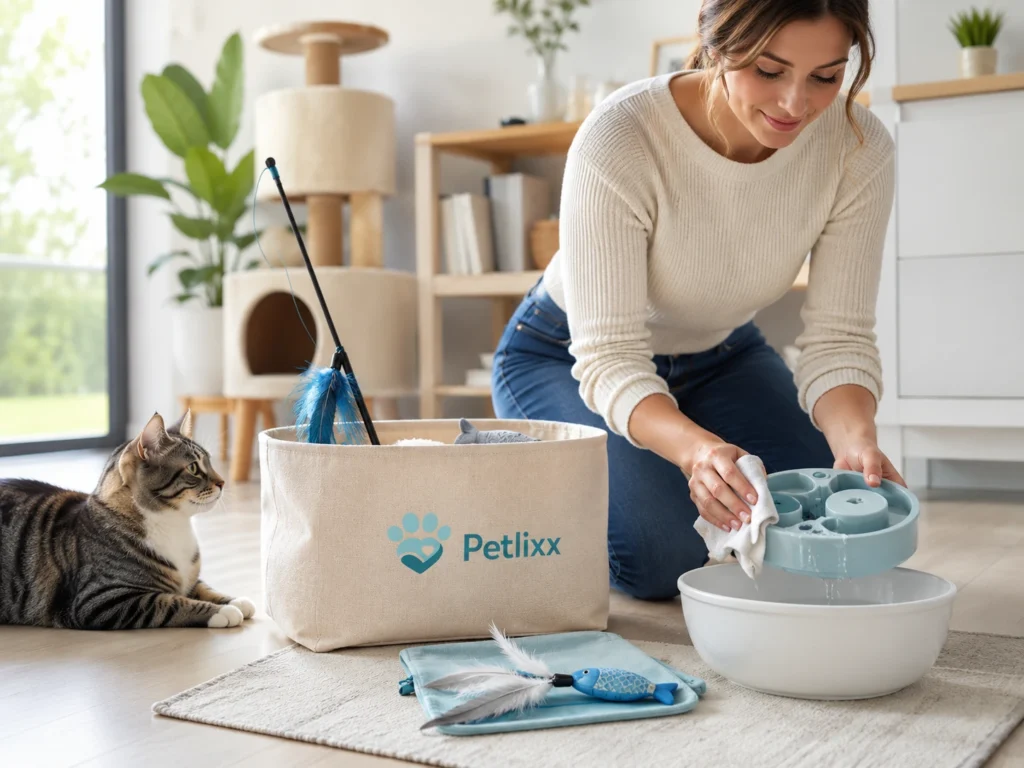
- Supervise wand toys, strings, wires, ribbons, feathers, and toys with small detachable parts.
- Store fishing-rod-style toys after each session so the line cannot become tangled around the cat.
- Inspect seams, attachments, batteries, and moving parts before use.
- Choose toys that are appropriate for the cat’s size, strength, and chewing habits.
- Clean food-based toys after use and count treats as part of the daily food allowance.
- Give the cat opportunities to catch the toy during chase play.
- Stop the session if the cat becomes frightened, breathless, painful, or unusually aggressive.
No list of interactive cat toys can replace observation. A toy that is safe for one cat may not be appropriate for a cat that chews plastic, tears fabric, or swallows small objects.
Frequently Asked Questions
What are the best interactive cat toys for indoor cats?
A balanced choice includes a guided hunting toy such as a wand, a food-based puzzle, and an independent batting, hiding, or kicking toy. The best combination depends on the cat’s preferred behavior.
How many interactive cat toys does one cat need?
A cat does not need a large pile of toys. A small rotation of three to five different activity types is usually more useful than many toys that all work the same way.
Can interactive cat toys be used every day?
Yes, suitable toys can be used daily. Vary the activity, keep sessions manageable, supervise risky attachments, and give the cat rest when interest drops.
Are automatic cat toys better than wand toys?
They serve different purposes. Automatic toys can add independent movement, while wand toys provide owner-led play, flexible movement, and bonding. Many cats benefit from both types.
Are puzzle feeders good for indoor cats?
Puzzle feeders can be useful for food-motivated cats when the challenge starts easy and food portions remain part of the normal daily allowance.
Should I leave wand toys out when I am not home?
No. Wand toys with string, wire, ribbon, feathers, or small attachments should be stored after supervised play.
How often should I rotate cat enrichment toys?
There is no fixed rule. Changing one or two toys every few days is a practical starting point. Bring back favorites after a short break and track which activities keep the cat engaged.
Final Thoughts
Interactive cat toys are most effective when they create variety instead of clutter. A wand supports shared hunting play, a puzzle feeder turns food into a small challenge, and a track, tunnel, kicker, or prey toy gives the cat another way to move and explore.
Start with a few different activity types, observe the cat’s response, and rotate toys before they become invisible background objects. The best setup is not the most expensive one; it is the one that is safe, repeatable, and matched to the cat’s natural preferences.
Begin with one guided toy and one independent activity, then add new options only when they provide a different type of play. A simple, well-chosen rotation is easier to manage and more useful than a large collection of toys your cat ignores.